Sales Invoice Form
Issue a sales invoice with line items, tax, due date and payment method for a completed order or service.
A ready-to-use finance, insurance & tax form for advisers, brokers and finance teams: 13 questions, 3 pages, 3 conditional rules.
- Questions
- 13
- Pages
- 3
- Layouts
- classic · card
- Conditional rules
- 3
Searches this template answers
- sales invoice form
- invoice form template
- create invoice online
- invoice with line items
- invoice due date form
- small business invoice template
Also filed under
Live preview and test console
This is the real form. Answer it to test the 1 conditional rule — nothing is sent or stored.
Page 1 of 3 — Invoice details
Every question on this page is currently visible.
Compliance checklist
- Payment items priced — passingEvery payment question charges a real amount, so a submission always records a payment.
- Conditional logic resolves — passingEvery rule points at a question or page that exists in this template.
- Financial disclaimer present — passingThis form does not provide financial, tax or legal advice. Any figures shown are indicative only and are not an offer of credit or a guarantee of terms. Please seek advice from a regulated adviser before making a decision.
- Question labels unique — passingLogic and exports address questions by label, so duplicates are ambiguous.
What happens after submit: nothing is stored in this preview. On your own copy, every response triggers an instant email notification and lands in your response dashboard, ready to export or forward.
Happy with it? Take a copy into your workspace — every question, rule and setting comes with it.
Who this template is for
Sales Invoice Form is built for advisers, brokers and finance teams who need to collect structured financial detail with a clear audit trail.
- Advisers, brokers and finance teams working in finance, insurance & tax.
- Teams who need to collect structured financial detail with a clear audit trail without writing code or paying for a custom build.
- Anyone replacing incomplete applications that fail compliance review with one structured record per enquiry.
- Respondents are clients and applicants — the form asks them 13 questions across 3 screens.
- Mobile-heavy audiences, thanks to the one-question-per-screen card layout.
Why this form is useful
It removes the cost of incomplete applications that fail compliance review and turns each submission into a record your team can act on immediately.
- 8 questions are required, so submissions arrive complete instead of needing a follow-up email.
- It collects a verified email address so replies and confirmations land.
- It pins the request to a specific date.
- It captures a full postal address.
- It allows multiple selections without free text.
- It captures a numeric value you can filter and sort on.
- Conditional logic hides 3 questions until they are relevant — shorter forms convert better than long ones.
- Splitting the form across 3 pages keeps each screen short and shows respondents how much is left.
How to use this template
From copy to live form is a few minutes of work, and every step is reversible.
- 1Press “Use this template” — a fresh copy of Sales Invoice Form lands in your workspace, ready to edit.
- 2Rename or delete any question, and change what is required. Nothing here is fixed.
- 3Open Notifications and add the email addresses that should be alerted on each submission; add an auto-reply to the respondent if the form collects an email address.
- 4Publish it, then either share the link directly or paste the embed snippet into your site — the embedded form resizes to fit and loads no marketing or advertising trackers.
- 5Watch responses land in Submissions, where you can filter, label and export them to CSV or PDF.
Logic and conditions blueprint
Exactly how this form behaves as it is answered — 3 conditional rules ship with it.
- Features advanced show logic: if “Payment terms” is Net 30, the form dynamically exposes “Late fee if unpaid after due date”. Otherwise that question never appears.
- Features advanced show logic: if “Payment terms” is Net 60, the form dynamically exposes “Late fee if unpaid after due date”. Otherwise that question never appears.
- Features conditional validation: if “How will the customer pay?” is Card payment link, “Payment link or reference” becomes mandatory before the form can be sent.
- All 3 rules are editable in the Logic tab, and the built-in checker warns about rules that contradict each other.
About this template
This template is the invoice itself — issued after work is done or goods have shipped — rather than the request that precedes it. It captures buyer and seller details, an itemised list of what is being billed, a tax rate and a due date, then closes with a payment-method note so the recipient knows how to pay. Unlike Invoice Request Form, which is a buyer-initiated ask for a bill to be created, this one is generated by the seller and sent out as the actual demand for payment, so it includes fields an internal request never needs: invoice number, due date and late-payment terms. A late-fee toggle only appears when payment terms extend beyond immediate payment, since same-day invoices rarely need one. Keeping the line items as a repeatable list rather than a single amount field means the same template works whether you're billing one consulting day or a multi-item product order. For businesses that also take card payments directly, pair this with Online Payment Form so the invoice can link straight to a payment page instead of asking the customer to arrange a bank transfer manually.
What this form asks
Every question is editable — rename it, make it optional, or delete it entirely.
Page 1 — Invoice details
- Invoice numberrequired
- Bill to (customer name)required
- Customer emailrequired
- Billing address
- Invoice daterequired
- Due daterequired
Page 2 — Charges
- Items or services billedrequired
- Tax rate (%)
- Payment termsrequired
- Late fee if unpaid after due date
Page 3 — Payment
- How will the customer pay?required
- Payment link or reference
- Notes for the customer
13 questions in total.
How the form changes as it's filled in
This template ships with 3 conditional rules, grouped into 3 behaviours driven by 2 questions. Everything below is already set up — edit or delete any rule once the template is in your workspace.
Driven by “Payment terms”
- Reveals questions
If “Payment terms” is Net 30, the form reveals “Late fee if unpaid after due date”.
- Reveals questions
If “Payment terms” is Net 60, the form reveals “Late fee if unpaid after due date”.
Driven by “How will the customer pay?”
- Makes answers required
If “How will the customer pay?” is Card payment link, “Payment link or reference” becomes required before the form can be submitted.
Set it up step by step
- 1
Number invoices sequentially
A consistent invoice number scheme makes reconciliation and follow-up on overdue accounts much easier.
- 2
State the due date plainly
"Net 30" means little to some customers — restate it as an actual calendar date on the invoice.
- 3
Only add a late fee when terms allow float
Immediate-payment invoices don't need one; the logic above only shows it for Net 30/60 terms.
- 4
Link out to payment instead of chasing manually
If you take cards, connect the payment-link field to Online Payment Form so customers can pay in one click.
Mistakes to avoid
- Sending an invoice without a due date, which makes late-payment follow-up unenforceable.
- Leaving tax rate blank in jurisdictions where it's required on every invoice.
- Reusing invoice numbers, which breaks reconciliation in accounting software.
What it pairs with
Most teams don't run this form on its own. These are the forms and systems it sits next to.
What to do with the responses
File a copy against the customer's account and set a reminder a few days before the due date so overdue invoices get chased promptly.
Works in both layouts
Forms that overlap this one
These pages cover the same subject ground as the sales invoice form, matched on the words people actually search for.
Payment Plan Request Form
accountingapplicationbookkeeperbusinesclaim
Invoice Request Form
accountingapplicationbookkeeperclaimclient
Invoice Payment Card
accountingapplicationclaimclientcredit
Online Payment Form
businesdetailfreelancerinvoiceorder
Price Quote Form
businesdateinvoiceitemline
Small Claims Case Intake
claimclientinvoiceservicesmall
Privacy & compliance
This form collects identity or financial details. Enable encrypted answers on the sensitive fields, avoid emailing full values in notifications, and delete responses once the check is complete.
Frequently asked questions
How is this different from Invoice Request Form?
Invoice Request Form is filled in by a customer or internal team asking someone to generate a bill. This Sales Invoice Form is the finished invoice itself, sent by the seller with line items, tax and a due date already set.
Can customers pay directly from this form?
Not on its own — it records payment intent and method. For direct card payment, link the payment-link field to Online Payment Form.
What if the invoice relates to a purchase order?
Reference the PO number in the notes field so it matches back to whatever was raised on Purchase Order Form.
Do I need a late fee field for every invoice?
No — it only makes sense once payment terms extend credit; same-day invoices can leave it blank.
Is the Sales Invoice Form template free to use?
Yes. You can preview and test Sales Invoice Form on this page without an account, and take a copy into your own HelloForms workspace on the free plan. There is nothing to install and no card required to publish it.
What does the Sales Invoice Form template ask for?
It asks 13 questions across 3 pages, 8 of which are required. Every question is listed in full further down this page, and each one can be renamed, reordered, made optional or deleted after you copy the template.
Can I edit the Sales Invoice Form form after copying it?
Yes — the copy is entirely yours. Change wording, add or remove questions, switch between the classic and card layouts, restyle it to match your brand, and set who gets notified on each submission.
How does the conditional logic in this finance, insurance & tax form work?
3 conditional rules ship with the template: Features advanced show logic: if “Payment terms” is Net 30, the form dynamically exposes “Late fee if unpaid after due date”. Otherwise that question never appears. Features advanced show logic: if “Payment terms” is Net 60, the form dynamically exposes “Late fee if unpaid after due date”. Otherwise that question never appears. Features conditional validation: if “How will the customer pay?” is Card payment link, “Payment link or reference” becomes mandatory before the form can be sent. All rules are editable in the Logic tab.
Where do responses to the Sales Invoice Form form go?
Submissions land in your workspace under Submissions, where you can search, filter, label and export them to CSV or PDF. You can also email a notification to your team on every submission and send the respondent an auto-reply.
Can I embed the Sales Invoice Form form on my own website?
Yes. Publish the form and paste the embed snippet into any page or share the direct link. The embedded form resizes to fit its container and loads no advertising or marketing trackers inside the iframe.
Related templates
More forms teams pair with the sales invoice form.
Related categories

Claim Notification Form
First notice of loss — report the incident fast, with the details an insurer needs to open a file.💰 Finance, Insurance & Tax14 questionsShort form — 14 questions across 2 pages.View template
Bookkeeping Client Intake
Onboard a bookkeeping client: entity and trading details, software and bank feeds, transaction volume, sales tax position, payroll and services wanted.💰 Finance, Insurance & Tax35 questionsMedium length — 35 questions across 3 pages.View template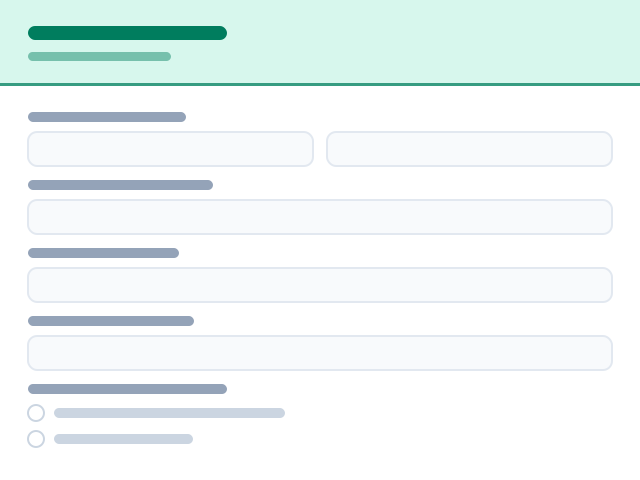
Insurance Claim Submission
Structured first-notice-of-loss claim with incident detail, evidence upload and declaration.💰 Finance, Insurance & Tax16 questionsShort form — 16 questions across 2 pages.View template
Purchase Approval Form
The approver's half of procurement: verify, set limits, approve or bounce with reasons.💰 Finance, Insurance & Tax10 questionsShort form — 10 questions on a single page.View template
Business Formation Intake Form
Capture structure, owners and revenue before recommending an entity.💰 Finance, Insurance & Tax11 questionsShort form — 11 questions across 2 pages.View template
Deposit & Payment Terms Agreement
Agree the deposit, milestone splits and final payment up front.💰 Finance, Insurance & Tax14 questionsShort form — 14 questions across 2 pages.View template