Class Evaluation Form
End-of-class feedback on the session, the instructor and the materials, with rated criteria and one improvement.
A ready-to-use education & schools form for schools, tutors and course providers: 19 questions, 3 pages, 4 conditional rules.
- Questions
- 19
- Pages
- 3
- Layouts
- classic · card
- Conditional rules
- 4
Searches this template answers
- class evaluation form
- class evaluation form sample
- class evaluation template
- sample class evaluation form
- student class evaluation form
- free class evaluation form template
Also filed under
Live preview and test console
This is the real form. Answer it to test the 2 conditional rules — nothing is sent or stored.
Page 1 of 3 — The class
Every question on this page is currently visible.
Compliance checklist
- Payment items priced — passingEvery payment question charges a real amount, so a submission always records a payment.
- Conditional logic resolves — passingEvery rule points at a question or page that exists in this template.
- Legal text not required — passingThis template collects neither health nor regulated financial information.
- Question labels unique — passingLogic and exports address questions by label, so duplicates are ambiguous.
What happens after submit: nothing is stored in this preview. On your own copy, every response triggers an instant email notification and lands in your response dashboard, ready to export or forward.
Happy with it? Take a copy into your workspace — every question, rule and setting comes with it.
Who this template is for
Class Evaluation Form is built for schools, tutors and course providers who need to enrol people and record permissions in one place.
- Schools, tutors and course providers working in education & schools.
- Teams who need to enrol people and record permissions in one place without writing code or paying for a custom build.
- Anyone replacing consent forms chased on paper the week before term with one structured record per enquiry.
- Respondents are students, parents and staff — the form asks them 19 questions across 3 screens.
- Mobile-heavy audiences, thanks to the one-question-per-screen card layout.
Why this form is useful
It removes the cost of consent forms chased on paper the week before term and turns each submission into a record your team can act on immediately.
- 6 questions are required, so submissions arrive complete instead of needing a follow-up email.
- It collects a verified email address so replies and confirmations land.
- It pins the request to a specific date.
- It scores satisfaction on a consistent scale.
- It measures sentiment on a numeric scale.
- Conditional logic hides 4 questions until they are relevant — shorter forms convert better than long ones.
- Splitting the form across 3 pages keeps each screen short and shows respondents how much is left.
- Every response is stored, searchable and exportable, so nothing depends on one person's inbox.
How to use this template
From copy to live form is a few minutes of work, and every step is reversible.
- 1Press “Use this template” — a fresh copy of Class Evaluation Form lands in your workspace, ready to edit.
- 2Rename or delete any question, and change what is required. Nothing here is fixed.
- 3Open Notifications and add the email addresses that should be alerted on each submission; add an auto-reply to the respondent if the form collects an email address.
- 4Publish it, then either share the link directly or paste the embed snippet into your site — the embedded form resizes to fit and loads no marketing or advertising trackers.
- 5Watch responses land in Submissions, where you can filter, label and export them to CSV or PDF.
Logic and conditions blueprint
Exactly how this form behaves as it is answered — 4 conditional rules ship with it.
- Features advanced show logic: if “How did you attend?” is Online, the form dynamically exposes “How well did the online setup work?”. Otherwise that question never appears.
- Features advanced show logic: if “How did you attend?” is Hybrid, the form dynamically exposes “How well did the online setup work?”. Otherwise that question never appears.
- Features conditional validation: if “Would you like a reply about anything you raised?” is Yes, “Email address” becomes mandatory before the form can be sent.
- Features advanced show logic: if “Did anything prevent you taking part?” is Yes, the form dynamically exposes “What got in the way?”. Otherwise that question never appears.
- All 4 rules are editable in the Logic tab, and the built-in checker warns about rules that contradict each other.
About this template
A course evaluation looks back over a whole term. A class evaluation asks about one session while it is still fresh, which is when the answers are specific enough to change something. This form opens with the class name, date and instructor, then asks how the session was attended — in person, online or hybrid — because online attendees get an extra question about audio, screen sharing and whether they could ask questions. Rated criteria cover clarity of explanation, pace, usefulness of the examples, quality of the handouts or slides, how well questions were answered, and how confident the learner now feels applying what was covered. Every rating sits next to a short open field so a low score arrives with a reason attached. The closing page asks the two questions that actually produce changes: what should be kept exactly as it is, and the single thing that would have made the session better. Respondents can stay anonymous, or leave a name and email when they want a reply about something raised.
What this form asks
Every question is editable — rename it, make it optional, or delete it entirely.
Page 1 — The class
- Class or session titlerequired
- Date of the classrequired
- Instructor
- How did you attend?required
Page 2 — Your ratings
- Clarity of the explanations
- Anything that was explained unclearly?
- Pace of the session
- Usefulness of the examples and activities
- Quality of the slides and handouts
- How well questions were answered
- How confident do you feel applying this?
- How well did the online setup work?
Page 3 — What to change
- What should stay exactly as it is?required
- One thing that would have made this class betterrequired
- Did anything prevent you taking part?
- What got in the way?
- Would you like a reply about anything you raised?
- Your name
- Email addressrequired
19 questions in total.
How the form changes as it's filled in
This template ships with 4 conditional rules, grouped into 4 behaviours driven by 3 questions. Everything below is already set up — edit or delete any rule once the template is in your workspace.
Driven by “How did you attend?”
- Reveals questions
If “How did you attend?” is Online, the form reveals “How well did the online setup work?”.
- Reveals questions
If “How did you attend?” is Hybrid, the form reveals “How well did the online setup work?”.
Driven by “Would you like a reply about anything you raised?”
- Makes answers required
If “Would you like a reply about anything you raised?” is Yes, “Email address” becomes required before the form can be submitted.
Driven by “Did anything prevent you taking part?”
- Reveals questions
If “Did anything prevent you taking part?” is Yes, the form reveals “What got in the way?”.
Set it up step by step
- 1
Send it while the room is still warm
Share the link in the last two minutes of the class or paste it into the chat — response rates fall off sharply after the same day.
- 2
Rename the criteria to match the class
A practical workshop and a lecture need different rows; edit the rating labels rather than adding more of them.
- 3
Keep it anonymous by default
Leave the name and email optional so critical feedback still arrives; the reply toggle handles the cases where someone wants an answer.
- 4
Read the two open questions first
The keep/change pair is where the actionable material is — the ratings are for tracking the trend across sessions.
Mistakes to avoid
- Asking twenty rating questions about a ninety-minute class, which halves completion.
- Making the name field required, which quietly removes the honest answers.
- Collecting evaluations all term and only reading them once the class has ended.
What it pairs with
Most teams don't run this form on its own. These are the forms and systems it sits next to.
What to do with the responses
Export the ratings per session to see whether pace or clarity is the recurring issue, and reply personally to anyone who asked for a response.
Works in both layouts
Forms that overlap this one
These pages cover the same subject ground as the class evaluation form, matched on the words people actually search for.
Course Evaluation Survey
academicclascourseeducationend
Instructor Evaluation Form
academicclascourseeducationenrollment
Student Class Survey
academicclascourseeducationenrollment
Course Evaluation Form
academicclascourseeducationend
Teacher Evaluation Form
academicclascoursecriteriaeducation
Assignment Submission Form
academicclascourseeducationenrollment
Frequently asked questions
How is this different from the course evaluation?
This one asks about a single class. The Course Evaluation Survey covers a full course or term, including assessment, workload and materials across weeks.
Can I use it for corporate training?
Yes. Rename "class" to "session" and the instructor field to "facilitator"; the Training Evaluation Form is the longer version if you also need learning-transfer questions.
Will students see each other's answers?
No. Responses are private to your workspace, and nothing is shown back to the person filling it in beyond their own confirmation.
Can I make it fully anonymous?
Delete the name and email fields and turn off IP capture in the form settings; the reply question can go with them.
Is the Class Evaluation Form template free to use?
Yes. You can preview and test Class Evaluation Form on this page without an account, and take a copy into your own HelloForms workspace on the free plan. There is nothing to install and no card required to publish it.
What does the Class Evaluation Form template ask for?
It asks 19 questions across 3 pages, 6 of which are required. Every question is listed in full further down this page, and each one can be renamed, reordered, made optional or deleted after you copy the template.
Can I edit the Class Evaluation Form form after copying it?
Yes — the copy is entirely yours. Change wording, add or remove questions, switch between the classic and card layouts, restyle it to match your brand, and set who gets notified on each submission.
How does the conditional logic in this education & schools form work?
4 conditional rules ship with the template: Features advanced show logic: if “How did you attend?” is Online, the form dynamically exposes “How well did the online setup work?”. Otherwise that question never appears. Features advanced show logic: if “How did you attend?” is Hybrid, the form dynamically exposes “How well did the online setup work?”. Otherwise that question never appears. Features conditional validation: if “Would you like a reply about anything you raised?” is Yes, “Email address” becomes mandatory before the form can be sent. All rules are editable in the Logic tab.
Where do responses to the Class Evaluation Form form go?
Submissions land in your workspace under Submissions, where you can search, filter, label and export them to CSV or PDF. You can also email a notification to your team on every submission and send the respondent an auto-reply.
Can I embed the Class Evaluation Form form on my own website?
Yes. Publish the form and paste the embed snippet into any page or share the direct link. The embedded form resizes to fit its container and loads no advertising or marketing trackers inside the iframe.
Related templates
More forms teams pair with the class evaluation form.
Related categories

Course Enrollment Form
Enrolment with programme choice, prior learning, payment preference and terms consent.🎓 Education & Schools14 questionsShort form — 14 questions across 2 pages.View template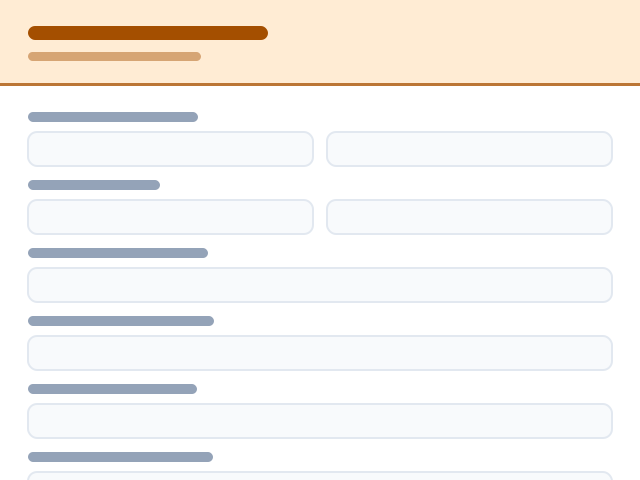
Classroom Observation Form
Lesson observation record with timed notes, rated teaching standards and agreed next steps.🎓 Education & Schools30 questionsMedium length — 30 questions across 3 pages.View template
Exam Registration Form
Register candidates for exam sittings — subject, level, access arrangements and fees.🎓 Education & Schools13 questionsShort form — 13 questions across 2 pages.View template
Transcript Request
One screen to request a transcript: student details, years attended, how many copies, where they should be sent and when they are needed by.🎓 Education & Schools12 questionsShort form — 12 questions on a single page.View template
Student Reading Log
Record daily reading minutes, book titles and a parent signature so teachers can track reading practice at home.🎓 Education & Schools9 questionsShort form — 9 questions on a single page.View template
Tardy Slip Form
Record a student's late arrival with the time, reason and issuing staff member for a consistent, searchable tardy record.🎓 Education & Schools8 questionsQuick to fill — 8 questions on a single page.View template