Direct Debit Mandate Form
Collect account details and written authority to take recurring payments from a customer.
A ready-to-use banking & identity form for small teams who need a reliable intake process: 23 questions, 4 pages, 3 conditional rules.
- Questions
- 23
- Pages
- 4
- Layouts
- classic
- Conditional rules
- 3
Searches this template answers
- direct debit mandate form
- direct debit authorisation form
- recurring payment authority form
- ach authorization form
- standing order mandate
- free direct debit form
Also filed under
Live preview and test console
This is the real form. Answer it to test the 1 conditional rule — nothing is sent or stored.
Page 1 of 4 — Account holder
Every question on this page is currently visible.
Compliance checklist
- Payment items priced — passingEvery payment question charges a real amount, so a submission always records a payment.
- Conditional logic resolves — passingEvery rule points at a question or page that exists in this template.
- Financial disclaimer present — passingThis form does not provide financial, tax or legal advice. Any figures shown are indicative only and are not an offer of credit or a guarantee of terms. Please seek advice from a regulated adviser before making a decision.
- Question labels unique — passingLogic and exports address questions by label, so duplicates are ambiguous.
What happens after submit: nothing is stored in this preview. On your own copy, every response triggers an instant email notification and lands in your response dashboard, ready to export or forward.
Happy with it? Take a copy into your workspace — every question, rule and setting comes with it.
Who this template is for
Direct Debit Mandate Form is built for small teams who need a reliable intake process who need to collect the same complete information from everyone.
- Small teams who need a reliable intake process working in banking & identity.
- Teams who need to collect the same complete information from everyone without writing code or paying for a custom build.
- Anyone replacing chasing missing details over email with one structured record per enquiry.
- Respondents are the people you send it to — the form asks them 23 questions across 4 screens.
Why this form is useful
It removes the cost of chasing missing details over email and turns each submission into a record your team can act on immediately.
- 16 questions are required, so submissions arrive complete instead of needing a follow-up email.
- It collects a verified email address so replies and confirmations land.
- It captures a phone number for urgent follow-up.
- It records a signature you can keep as proof of agreement.
- It pins the request to a specific date.
- It captures a full postal address.
- It captures a numeric value you can filter and sort on.
- Conditional logic hides 3 questions until they are relevant — shorter forms convert better than long ones.
How to use this template
From copy to live form is a few minutes of work, and every step is reversible.
- 1Press “Use this template” — a fresh copy of Direct Debit Mandate Form lands in your workspace, ready to edit.
- 2Rename or delete any question, and change what is required. Nothing here is fixed.
- 3Open Notifications and add the email addresses that should be alerted on each submission; add an auto-reply to the respondent if the form collects an email address.
- 4Publish it, then either share the link directly or paste the embed snippet into your site — the embedded form resizes to fit and loads no marketing or advertising trackers.
- 5Watch responses land in Submissions, where you can filter, label and export them to CSV or PDF.
Logic and conditions blueprint
Exactly how this form behaves as it is answered — 3 conditional rules ship with it.
- Features advanced show logic: if “Is the amount fixed or variable?” is Variable, the form dynamically exposes “Notice given before each collection”. Otherwise that question never appears.
- Features conditional validation: if “Are you the sole account holder?” is No, “Second account holder name” becomes mandatory before the form can be sent.
- Features conditional validation: if “Do you want a copy sent to another address?” is Yes, “Copy-to email address” becomes mandatory before the form can be sent.
- All 3 rules are editable in the Logic tab, and the built-in checker warns about rules that contradict each other.
About this template
A direct debit mandate is a short form that has to be exactly right, because an error in a sort code or an account number turns into a failed collection and a chased customer. This template collects the account holder's name as it appears on the account, the bank name, the account number and the branch or routing code, with number validation on the fields that have a fixed length. It records the address held by the bank so the mandate can be matched, and the customer reference your billing system uses, so the payment reconciles automatically instead of landing in a suspense account. The payment section captures what is being paid for, the amount type — fixed, variable or usage-based — the collection frequency, the first collection date and whether the amount can change with notice. A variable amount opens a question about the notice period you will give before each collection, which is the part most mandates forget. Advance notice preferences, a copy-to email and an optional purchase order reference keep finance teams happy. The authority text, signature and date are stored with the submission so you can produce the signed mandate on demand.
What this form asks
Every question is editable — rename it, make it optional, or delete it entirely.
Page 1 — Account holder
- Account holder name as it appears on the accountrequired
- Are you the sole account holder?required
- Second account holder name
- Address held by your bank
- Email addressrequired
- Contact number
Page 2 — Bank details
- Bank or building society namerequired
- Account numberrequired
- Sort code or routing numberrequired
- IBAN if applicable
- Customer or billing referencerequired
Page 3 — The payments
- What are these payments for?required
- Is the amount fixed or variable?required
- Amount per collection
- Notice given before each collection
- Collection frequencyrequired
- First collection daterequired
- Do you want a copy sent to another address?required
- Copy-to email addressrequired
- Purchase order reference
Page 4 — Authority
- Agreementrequired
- Account holder signaturerequired
- Date signedrequired
23 questions in total.
How the form changes as it's filled in
This template ships with 3 conditional rules, grouped into 3 behaviours driven by 3 questions. Everything below is already set up — edit or delete any rule once the template is in your workspace.
Driven by “Is the amount fixed or variable?”
- Reveals questions
If “Is the amount fixed or variable?” is Variable, the form reveals “Notice given before each collection”.
Driven by “Are you the sole account holder?”
- Makes answers required
If “Are you the sole account holder?” is No, “Second account holder name” becomes required before the form can be submitted.
Driven by “Do you want a copy sent to another address?”
- Makes answers required
If “Do you want a copy sent to another address?” is Yes, “Copy-to email address” becomes required before the form can be submitted.
Set it up step by step
- 1
Copy the template
Take a copy into your workspace and rename it for the service the payments relate to.
- 2
Match your scheme's wording
Replace the authority text with the exact wording your payment scheme or provider requires.
- 3
Add your reference format
Set the customer reference question to match the format your billing system expects so payments reconcile.
- 4
Collect and store
Send the link, collect the signed mandate, and export it as a PDF alongside the customer record.
Works in this layout
Forms that overlap this one
These pages cover the same subject ground as the direct debit mandate form, matched on the words people actually search for.
ACH Authorization Form
accountachapplicationauthorizationbank
Direct Deposit Authorization Form
accountadministratorapplicationauthorizationbank
Bank Account Opening Form
accountapplicationbankbankingbeneficial
Business Bank Account Application Form
accountapplicationbankbankingbeneficial
Business Credit Application Form
accountapplicationbankbankingbeneficial
Payment Details Update Form
accountapplicationbankbankingbeneficial
Privacy & compliance
This form collects identity or financial details. Enable encrypted answers on the sensitive fields, avoid emailing full values in notifications, and delete responses once the check is complete.
Frequently asked questions
Does this set up the collection with my provider?
No — it captures the signed authority. Export the mandate or connect the submission to the provider you already collect through.
Can I use my scheme's exact wording?
Yes. The authority text is a normal editable block, so paste in the wording your scheme mandates.
Are the bank fields validated?
Account and sort code answers accept the formats you configure, so obvious mistyping is caught before submission.
What about joint accounts?
Answer that you are not the sole holder and the second account holder question becomes required.
Is the Direct Debit Mandate Form template free to use?
Yes. You can preview and test Direct Debit Mandate Form on this page without an account, and take a copy into your own HelloForms workspace on the free plan. There is nothing to install and no card required to publish it.
What does the Direct Debit Mandate Form template ask for?
It asks 23 questions across 4 pages, 16 of which are required. Every question is listed in full further down this page, and each one can be renamed, reordered, made optional or deleted after you copy the template.
Can I edit the Direct Debit Mandate Form form after copying it?
Yes — the copy is entirely yours. Change wording, add or remove questions, switch between the classic layout, restyle it to match your brand, and set who gets notified on each submission.
How does the conditional logic in this banking & identity form work?
3 conditional rules ship with the template: Features advanced show logic: if “Is the amount fixed or variable?” is Variable, the form dynamically exposes “Notice given before each collection”. Otherwise that question never appears. Features conditional validation: if “Are you the sole account holder?” is No, “Second account holder name” becomes mandatory before the form can be sent. Features conditional validation: if “Do you want a copy sent to another address?” is Yes, “Copy-to email address” becomes mandatory before the form can be sent. All rules are editable in the Logic tab.
Where do responses to the Direct Debit Mandate Form form go?
Submissions land in your workspace under Submissions, where you can search, filter, label and export them to CSV or PDF. You can also email a notification to your team on every submission and send the respondent an auto-reply.
Can I embed the Direct Debit Mandate Form form on my own website?
Yes. Publish the form and paste the embed snippet into any page or share the direct link. The embedded form resizes to fit its container and loads no advertising or marketing trackers inside the iframe.
Is the signature on this form legally usable?
The template captures a drawn signature and stores it with the submission, along with the timestamp, so you keep evidence of who agreed and when. Whether that is sufficient depends on your jurisdiction and the agreement itself.
Related templates
More forms teams pair with the direct debit mandate form.
Related categories

ACH Authorization Form
Collect written permission for ACH debits, with routing details, amount, frequency and a signed mandate.🏦 Banking & Identity20 questionsShort form — 20 questions across 4 pages.View template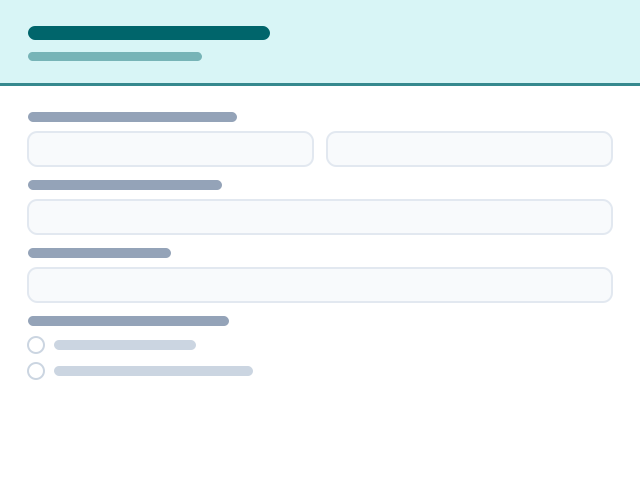
Direct Deposit Authorization Form
Payroll direct deposit setup with routing and account details, split-deposit logic and a voided cheque upload.🏦 Banking & Identity19 questionsShort form — 19 questions across 4 pages.View template
Payment Details Update Form
Let customers or suppliers change their bank details with verification steps that reduce fraud.🏦 Banking & Identity25 questionsMedium length — 25 questions across 4 pages.View template
Transaction Dispute Claim Form
Collect the transaction, reason and evidence needed to raise a payment dispute or chargeback.🏦 Banking & Identity27 questionsMedium length — 27 questions across 5 pages.View template
KYC Identity Verification Form
Run a structured know-your-customer check with documents, source of funds and screening answers.🏦 Banking & Identity35 questionsMedium length — 35 questions across 5 pages.View template
Mortgage Enquiry Form
Qualify a mortgage enquiry with property, deposit, income and affordability details up front.🏦 Banking & Identity33 questionsMedium length — 33 questions across 5 pages.View template