Notice to Vacate
One screen for a tenant to give notice: the last day of occupation, keys and forwarding address, viewing access and how the deposit should be returned.
A ready-to-use real estate & property form for agents, lettings teams and property managers: 11 questions, 1 page.
- Questions
- 11
- Pages
- 1
- Layouts
- card · classic
- Time to complete
- ≈ 4 min
Searches this template answers
- notice to vacate form
- tenant notice to vacate template
- moving out notice form online
- end of tenancy notice form
- 30 day notice to vacate form
Also filed under
Live preview and test console
This is the real form. Answer it to test the flow — nothing is sent or stored.
This template runs as a straight sequence — no branching rules.
Compliance checklist
- Payment items priced — passingEvery payment question charges a real amount, so a submission always records a payment.
- Conditional logic resolves — passingEvery rule points at a question or page that exists in this template.
- Legal text not required — passingThis template collects neither health nor regulated financial information.
- Question labels unique — passingLogic and exports address questions by label, so duplicates are ambiguous.
What happens after submit: nothing is stored in this preview. On your own copy, every response triggers an instant email notification and lands in your response dashboard, ready to export or forward.
Happy with it? Take a copy into your workspace — every question, rule and setting comes with it.
Who this template is for
Notice to Vacate is built for agents, lettings teams and property managers who need to pre-qualify enquiries and gather documents up front.
- Agents, lettings teams and property managers working in real estate & property.
- Teams who need to pre-qualify enquiries and gather documents up front without writing code or paying for a custom build.
- Anyone replacing viewings booked with people who were never eligible with one structured record per enquiry.
- Respondents are buyers, renters and landlords — the form asks them 11 questions across 1 screen.
- Mobile-heavy audiences, thanks to the one-question-per-screen card layout.
Why this form is useful
It removes the cost of viewings booked with people who were never eligible and turns each submission into a record your team can act on immediately.
- 8 questions are required, so submissions arrive complete instead of needing a follow-up email.
- It collects a verified email address so replies and confirmations land.
- It records a signature you can keep as proof of agreement.
- It pins the request to a specific date.
- It captures a full postal address.
- Every response is stored, searchable and exportable, so nothing depends on one person's inbox.
How to use this template
From copy to live form is a few minutes of work, and every step is reversible.
- 1Press “Use this template” — a fresh copy of Notice to Vacate lands in your workspace, ready to edit.
- 2Rename or delete any question, and change what is required. Nothing here is fixed.
- 3Open Notifications and add the email addresses that should be alerted on each submission; add an auto-reply to the respondent if the form collects an email address.
- 4Publish it, then either share the link directly or paste the embed snippet into your site — the embedded form resizes to fit and loads no marketing or advertising trackers.
- 5Watch responses land in Submissions, where you can filter, label and export them to CSV or PDF.
Logic and conditions blueprint
Exactly how this form behaves as it is answered.
- This template runs as a straight sequence: every respondent sees every question, in order.
- You can add branching yourself in the Logic tab — pick a question, a condition, and the field or page it should reveal, hide, require or skip to.
About this template
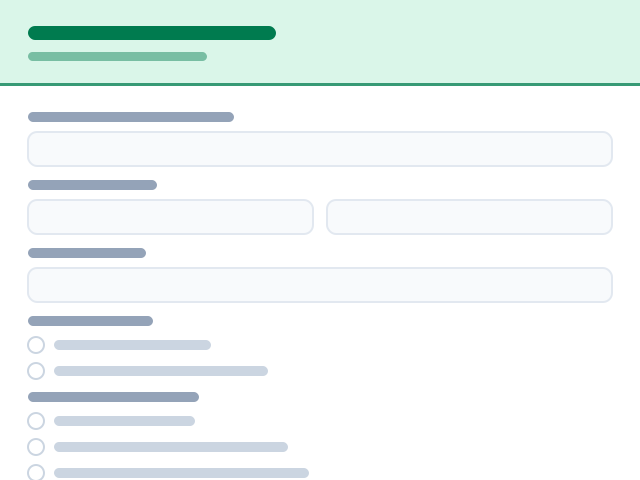
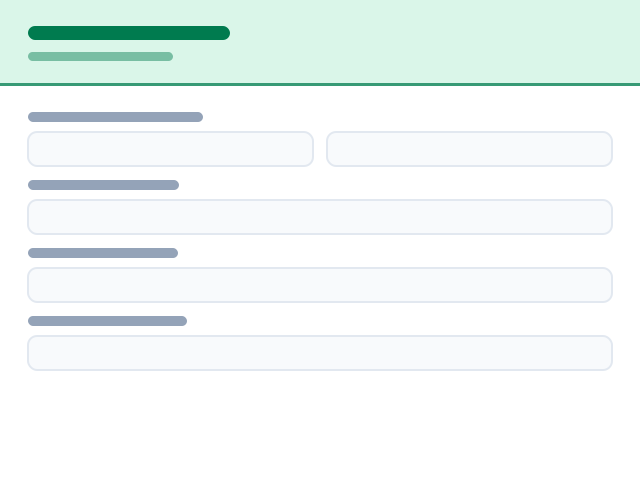
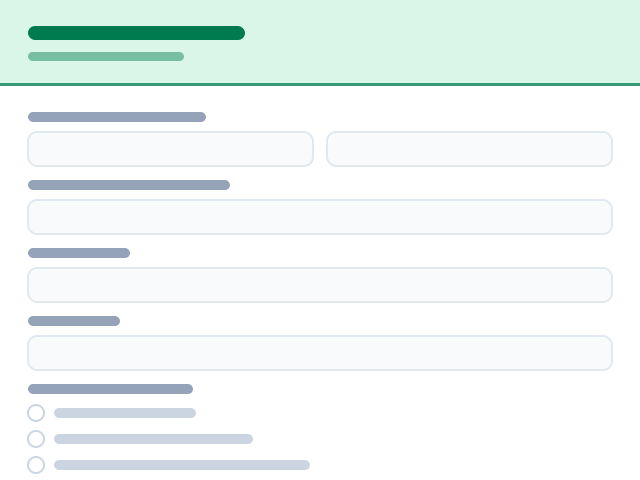
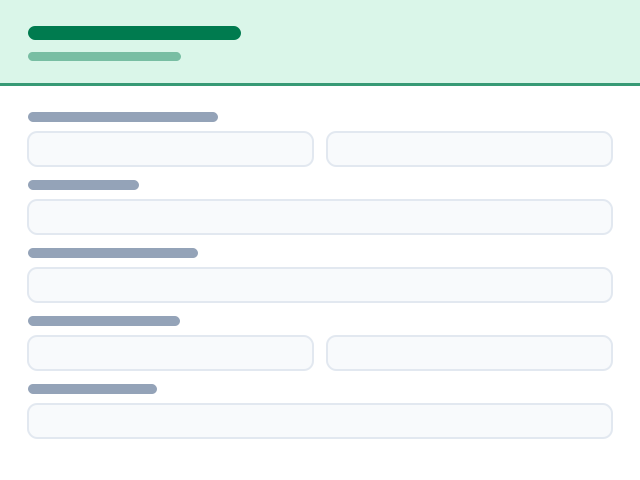
Notice given in a text message is notice nobody can date, and the deposit argument that follows is entirely avoidable. This screen makes it formal in about a minute. It records the property, the date notice is being given and the intended last day of occupation, then handles the practical end of a tenancy: how keys are returned, whether the property may be shown to prospective tenants during notice, and anything at the property that needs attention before the tenant leaves. The forwarding address is collected here because it is needed for the deposit and for post, and it is much harder to get once someone has gone. It closes with the tenant's preferred method for the deposit return and a signature, so the file holds a single dated document instead of a scroll of messages.
What this form asks
Every question is editable — rename it, make it optional, or delete it entirely.
Notice to vacate
- Property address
- Tenant namerequired
- Email addressrequired
- Date you are giving noticerequired
- Last day you will occupy the propertyrequired
- How will keys be returned?required
- May the property be shown during your notice?required
- Anything at the property needing attention before you leave
- Forwarding address
- How should the deposit be returned?required
- Tenant signaturerequired
11 questions in total.
Example of a completed notice to vacate form
This shows how a tenant gives dated notice and sets out the practical arrangements for leaving.
- Property address
- 22 Birch Row
- Date you are giving notice
- 5 January 2026
- Last day you will occupy the property
- 4 February 2026
- How will keys be returned?
- Dropped at the letting agent's office
- May the property be shown during your notice?
- Yes, with notice
- Forwarding address
- 8 Elm Street, Apartment 3
- How should the deposit be returned?
- Bank transfer
Sample data — no real people, addresses or records are shown.
Set it up step by step
- 1
Separate the notice date from the leaving date
Two fields are what make a notice period measurable, and they are the first thing questioned in a dispute.
- 2
Agree viewing access on the form
Recording whether the property may be shown during notice avoids friction every time a prospective tenant wants to look round.
- 3
Collect the forwarding address now
It is needed for the deposit and for post, and it is far harder to obtain after the keys are handed back.
- 4
Ask about repairs before the final inspection
A repair flagged during notice is a repair; the same issue found at check-out becomes a deduction argument.
Mistakes to avoid
- Accepting notice by message, leaving no dated document when the notice period is disputed.
- Booking the final inspection without warning the tenant, then having nobody there to agree the condition.
- Losing the forwarding address once the tenant has moved, delaying the deposit return.
What it pairs with
Most teams don't run this form on its own. These are the forms and systems it sits next to.
What to do with the responses
Acknowledge the notice with its date, confirm the last day and the inspection appointment, and start marketing the property if it is being re-let.
Works in both layouts
Forms that overlap this one
These pages cover the same subject ground as the notice to vacate, matched on the words people actually search for.
Security Deposit Return Request
addresagentapplicationdepositestate
Move-Out Cleaning Booking
agentdepositendkeylandlord
Move-In and Move-Out Inspection
agentapplicationdepositestatehousing
Rental Application Form
agentapplicationestatehousinglandlord
Roommate Agreement
applicationdepositestategivehousing
Guarantor Application Form
agentapplicationestatehousinglandlord
Privacy & compliance
This form takes money. Card details are handled by the payment provider and never stored in your response data — you keep the order details, not the card number.
Frequently asked questions
Does this end the tenancy on its own?
It records the tenant's written notice. Whether that validly ends the tenancy depends on your agreement and local rules.
How is it different from a check-out inventory?
This gives notice. The inspection form records the condition of the property at the end of the tenancy.
Can a landlord use it to give notice?
No. Landlord notices usually have prescribed forms and wording, so use the route your local rules require.
Why does it ask about viewing access?
So the notice period is not spent arguing over every visit a prospective tenant wants to make.
Is the Notice to Vacate template free to use?
Yes. You can preview and test Notice to Vacate on this page without an account, and take a copy into your own HelloForms workspace on the free plan. There is nothing to install and no card required to publish it.
What does the Notice to Vacate template ask for?
It asks 11 questions across 1 page, 8 of which are required. Every question is listed in full further down this page, and each one can be renamed, reordered, made optional or deleted after you copy the template.
Can I edit the Notice to Vacate form after copying it?
Yes — the copy is entirely yours. Change wording, add or remove questions, switch between the card and classic layouts, restyle it to match your brand, and set who gets notified on each submission.
Can I add conditional logic to this real estate & property form?
Yes. The template runs as a straight sequence out of the box, and you can add show, hide, require or skip rules in the Logic tab — pick a question, a condition, and the field or page it should affect.
Where do responses to the Notice to Vacate form go?
Submissions land in your workspace under Submissions, where you can search, filter, label and export them to CSV or PDF. You can also email a notification to your team on every submission and send the respondent an auto-reply.
Can I embed the Notice to Vacate form on my own website?
Yes. Publish the form and paste the embed snippet into any page or share the direct link. The embedded form resizes to fit its container and loads no advertising or marketing trackers inside the iframe.
Is the signature on this form legally usable?
The template captures a drawn signature and stores it with the submission, along with the timestamp, so you keep evidence of who agreed and when. Whether that is sufficient depends on your jurisdiction and the agreement itself.
Related templates
More forms teams pair with the notice to vacate.
Related categories
Property Viewing Request Form
Viewing requests qualified up front: budget, timing, position and pre-approval status.🏡 Real Estate & Property12 questionsShort form — 12 questions on a single page.View templateQuick Viewing Request
Four-field request to view a property, tied to the listing reference.🏡 Real Estate & Property5 questionsQuick to fill — 5 questions on a single page.View templateProperty Viewing / Open House Sign-In
Fast visitor intake for showings, with buying timeline and agent follow-up consent.🏡 Real Estate & Property10 questionsShort form — 10 questions across 2 pages.View templateProperty Viewing Card
Book a viewing in seconds: property, timing and buying position.🏡 Real Estate & Property9 questionsShort form — 9 questions on a single page.View templateGuarantor Application Form
Guarantor details and financial information form for tenancy applications requiring a rent guarantee.🏡 Real Estate & Property14 questionsShort form — 14 questions across 3 pages.View templateInventory and Check-In Form
Room-by-room property inventory and condition record completed at tenancy check-in, with photos and meter readings.🏡 Real Estate & Property18 questionsShort form — 18 questions across 3 pages.View template