Training Needs Assessment
Skills-gap survey that turns team self-ratings into a prioritised training plan.
A ready-to-use human resources form for HR, people ops and hiring managers: 15 questions, 2 pages, 3 conditional rules.
- Questions
- 15
- Pages
- 2
- Layouts
- classic · card
- Conditional rules
- 3
Searches this template answers
Live preview and test console
This is the real form. Answer it to test the 2 conditional rules — nothing is sent or stored.
Page 1 of 2 — About you
Every question on this page is currently visible.
Compliance checklist
- Payment items priced — passingEvery payment question charges a real amount, so a submission always records a payment.
- Conditional logic resolves — passingEvery rule points at a question or page that exists in this template.
- Legal text not required — passingThis template collects neither health nor regulated financial information.
- Question labels unique — passingLogic and exports address questions by label, so duplicates are ambiguous.
What happens after submit: nothing is stored in this preview. On your own copy, every response triggers an instant email notification and lands in your response dashboard, ready to export or forward.
Happy with it? Take a copy into your workspace — every question, rule and setting comes with it.
Who this template is for
Training Needs Assessment is built for HR, people ops and hiring managers who need to run hiring and internal people processes on one auditable record.
- HR, people ops and hiring managers working in human resources.
- Teams who need to run hiring and internal people processes on one auditable record without writing code or paying for a custom build.
- Anyone replacing CVs, requests and approvals scattered across inboxes with one structured record per enquiry.
- Respondents are candidates and employees — the form asks them 15 questions across 2 screens.
- Mobile-heavy audiences, thanks to the one-question-per-screen card layout.
Why this form is useful
It removes the cost of CVs, requests and approvals scattered across inboxes and turns each submission into a record your team can act on immediately.
- 10 questions are required, so submissions arrive complete instead of needing a follow-up email.
- It collects a verified email address so replies and confirmations land.
- It scores satisfaction on a consistent scale.
- It captures a numeric value you can filter and sort on.
- Conditional logic hides 3 questions until they are relevant — shorter forms convert better than long ones.
- Splitting the form across 2 pages keeps each screen short and shows respondents how much is left.
- Every response is stored, searchable and exportable, so nothing depends on one person's inbox.
How to use this template
From copy to live form is a few minutes of work, and every step is reversible.
- 1Press “Use this template” — a fresh copy of Training Needs Assessment lands in your workspace, ready to edit.
- 2Rename or delete any question, and change what is required. Nothing here is fixed.
- 3Open Notifications and add the email addresses that should be alerted on each submission; add an auto-reply to the respondent if the form collects an email address.
- 4Publish it, then either share the link directly or paste the embed snippet into your site — the embedded form resizes to fit and loads no marketing or advertising trackers.
- 5Watch responses land in Submissions, where you can filter, label and export them to CSV or PDF.
Logic and conditions blueprint
Exactly how this form behaves as it is answered — 3 conditional rules ship with it.
- Features advanced show logic: if “Top skill you want to develop” is Other, the form dynamically exposes “Describe the skill”. Otherwise that question never appears.
- Features conditional validation: if “Top skill you want to develop” is Other, “Describe the skill” becomes mandatory before the form can be sent.
- Features advanced show logic: if “Has your manager approved this request?” is No, the form dynamically exposes “Manager email”. Otherwise that question never appears.
- All 3 rules are editable in the Logic tab, and the built-in checker warns about rules that contradict each other.
About this template
Training budgets are usually spent on whatever the loudest manager asked for. This assessment replaces that with a comparable dataset: every employee self-rates the same five capability areas, names the one skill they most want to develop, and states the format they would actually turn up to. Because the ratings use identical wording across departments, the gaps aggregate into a heat map rather than a wish list. Format preference is the question that quietly saves the most money — booking classroom workshops for a team that wanted coaching is the most common way L&D spend disappears. Manager approval is captured up front, and answering no reveals a manager email so the request is routed rather than stalled. An "other" skill answer requires a description, keeping the free text usable. Run it annually before budget setting, then use the course enrolment form to book whatever the results justify.
What this form asks
Every question is editable — rename it, make it optional, or delete it entirely.
Page 1 — About you
- Full namerequired
- Departmentrequired
- Role level
- Years in role
- Self-rating: technical skillsrequired
- Self-rating: communicationrequired
- Self-rating: leadershiprequired
- Self-rating: tools and systemsrequired
- Self-rating: compliance knowledgerequired
Page 2 — What you need
- Top skill you want to developrequired
- Describe the skill
- Preferred formatrequired
- Best time for training
- Has your manager approved this request?
- Manager emailrequired
15 questions in total.
How the form changes as it's filled in
This template ships with 3 conditional rules, grouped into 3 behaviours driven by 2 questions. Everything below is already set up — edit or delete any rule once the template is in your workspace.
Driven by “Top skill you want to develop”
- Reveals questions
If “Top skill you want to develop” is Other, the form reveals “Describe the skill”.
- Makes answers required
If “Top skill you want to develop” is Other, “Describe the skill” becomes required before the form can be submitted.
Driven by “Has your manager approved this request?”
- Reveals questions
If “Has your manager approved this request?” is No, the form reveals “Manager email”.
Set it up step by step
- 1
Run it before the budget round
Results arriving after the numbers are set become next year's problem instead of this year's plan.
- 2
Aggregate by department first
Five self-ratings across a team show where a cohort course beats individual bookings.
- 3
Respect the format answers
A team that asked for coaching will not attend a classroom day, however good the trainer is.
- 4
Publish the plan you build from it
Showing which requests were funded is what keeps next year's response rate high.
Mistakes to avoid
- Letting each department write its own skill list, which makes cross-team comparison impossible.
- Treating self-ratings as objective measures rather than a prioritisation signal.
- Collecting requests without a manager routing step, so approvals stall for weeks.
What it pairs with
Most teams don't run this form on its own. These are the forms and systems it sits next to.
What to do with the responses
Aggregate the self-ratings into a departmental heat map, prioritise the most requested skills, and book cohorts through the Course Enrollment Form.
Works in both layouts
Forms that overlap this one
These pages cover the same subject ground as the training needs assessment, matched on the words people actually search for.
Skills Assessment Form
analysiassessmentgaphiringlead
Training Evaluation Form
employeeemploymenthiringhrhuman
Training Request Form
developmentemployeeemploymenthiringhr
Exit Interview Form
employeeemploymenthiringhrhuman
Employee Performance Review
developmentemployeeemploymenthiringhr
Internal Transfer Request
departmentemployeeemploymenthiringhr
Privacy & compliance
This form holds employee or applicant data. Route it to a named HR mailbox rather than a shared inbox, and keep the audit trail on so you can show who viewed each response.
Frequently asked questions
Are self-ratings reliable?
As a prioritisation signal, yes. They tell you where people feel unsupported, which is what drives attendance and completion.
Should it be anonymous?
No — names and manager routing are what turn this into bookings. Aggregate before sharing results widely.
How often should we run it?
Annually before budget planning, with a shorter mid-year check if the team is growing quickly.
What comes next after the results?
Use the Course Enrollment Form to book the cohorts, then the Class Evaluation Form to check the training landed.
Is the Training Needs Assessment template free to use?
Yes. You can preview and test Training Needs Assessment on this page without an account, and take a copy into your own HelloForms workspace on the free plan. There is nothing to install and no card required to publish it.
What does the Training Needs Assessment template ask for?
It asks 15 questions across 2 pages, 10 of which are required. Every question is listed in full further down this page, and each one can be renamed, reordered, made optional or deleted after you copy the template.
Can I edit the Training Needs Assessment form after copying it?
Yes — the copy is entirely yours. Change wording, add or remove questions, switch between the classic and card layouts, restyle it to match your brand, and set who gets notified on each submission.
How does the conditional logic in this human resources form work?
3 conditional rules ship with the template: Features advanced show logic: if “Top skill you want to develop” is Other, the form dynamically exposes “Describe the skill”. Otherwise that question never appears. Features conditional validation: if “Top skill you want to develop” is Other, “Describe the skill” becomes mandatory before the form can be sent. Features advanced show logic: if “Has your manager approved this request?” is No, the form dynamically exposes “Manager email”. Otherwise that question never appears. All rules are editable in the Logic tab.
Where do responses to the Training Needs Assessment form go?
Submissions land in your workspace under Submissions, where you can search, filter, label and export them to CSV or PDF. You can also email a notification to your team on every submission and send the respondent an auto-reply.
Can I embed the Training Needs Assessment form on my own website?
Yes. Publish the form and paste the embed snippet into any page or share the direct link. The embedded form resizes to fit its container and loads no advertising or marketing trackers inside the iframe.
Related templates
More forms teams pair with the training needs assessment.
Related categories
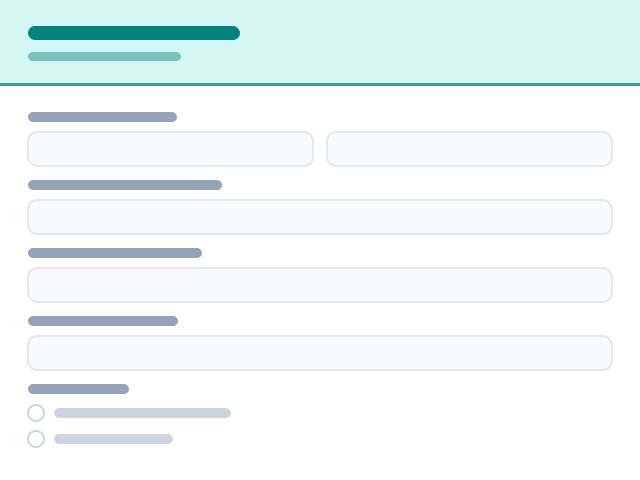
Job Application Form
The default job application form — candidate details, work history, resume upload and availability in one page.🧑💼 Human Resources13 questionsShort form — 13 questions on a single page.View template
Parental Leave Request
Request parental leave with the dates that matter: the due or placement date, planned start and end, shared leave, pay arrangements and a return plan.🧑💼 Human Resources30 questionsMedium length — 30 questions across 3 pages.View template
Return to Work Form
Bring employees back safely and on the record — absence details, fitness confirmation, adjustments and sign-off.🧑💼 Human Resources12 questionsShort form — 12 questions across 2 pages.View template
Employee Grievance
Raise a formal, named grievance: what happened with dates, who was involved, what has been tried informally, the outcome sought and a hearing arrangement.🧑💼 Human Resources30 questionsMedium length — 30 questions across 3 pages.View template
Resignation Notice
Give notice in writing: last working day, notice period, reason if offered, handover owner, equipment to return and where the final payslip should go.🧑💼 Human Resources16 questionsShort form — 16 questions on a single page.View template
Workspace Equipment Request
One screen to request a desk setup or equipment: what is needed and why, where it should be delivered, budget approval and whether it replaces existing kit.🧑💼 Human Resources11 questionsShort form — 11 questions on a single page.View template